Best Practices
This article describes proven practices for four critical decision points in project planning with Rillsoft Project: building a clean project structure, planning resource demand, preparing portfolio reviews, and saving baselines at the right time.
Build A Clean Project Structure
A clean project structure is the foundation for reliable scheduling, understandable capacity balancing, and meaningful variance analysis. Structural mistakes at the beginning create follow-up errors in every later planning phase.
Basic rule: structure before dates
Clarify the business structure before entering durations, dates, or resources. Detailed work does not improve a poorly structured plan.
Good project structure:
Each subproject represents a coherent unit, such as phase, role group, deliverable, site, or department.
Activity names describe a result or a completed piece of work.
The structure is readable for project managers, resource managers, and management.
Milestones mark real decision points, not every minor interim step.
Avoid common structure errors:
Error |
Better approach |
|---|---|
All activities on one level |
Use subprojects for business sections. |
Too many levels |
Reduce levels and move excessive detail into subproject files. |
Activity names such as “work on X” |
Use result-oriented names such as “X approved”. |
One activity for a six-month phase |
Split phases into controllable activities. |
Milestones for every activity |
Use milestones for approvals, delivery dates, and phase transitions. |
Links as a structure check:
If activities do not form a logical sequence after linking, or the critical path is hard to understand, the cause is often a structure problem. In that case, check the structure first before adjusting links.
Plan Role Demand Before Employee Assignment
The most common resource planning error is assigning employees before qualification-based demand is understood. This creates overloads that become visible too late and capacity decisions without a reliable basis.
Principle:
Activities first receive roles or professional qualifications, not names.
Capacity balancing shows whether enough qualified capacity is available.
Named employees are assigned only after capacity balancing.
This approach is especially useful when several projects compete for the same resource pool, when absences matter, or when the organisation needs to know whether projects are feasible before committing named people.
When direct assignment is sufficient:
a small project with a few clearly assigned people
the project manager knows availability directly
no competition with other projects
After employee assignment, check:
Does capacity balancing show shortfall or overload?
Does the employee’s qualification match the assigned role?
Are working times and non-working days maintained?
Is the assignment plausible in portfolio context?
Prepare Portfolio Reviews
A portfolio review prepares decisions, not reports. A report shows the current state. A review should help decision makers change priorities, resources, or dates when needed.
Before the review, update:
project status of all active projects
project priorities
baseline status and current progress
resource utilisation in the portfolio horizon
cross-project links and delays
Three core questions:
Is the portfolio feasible?
Which projects are at risk?
What must be decided?
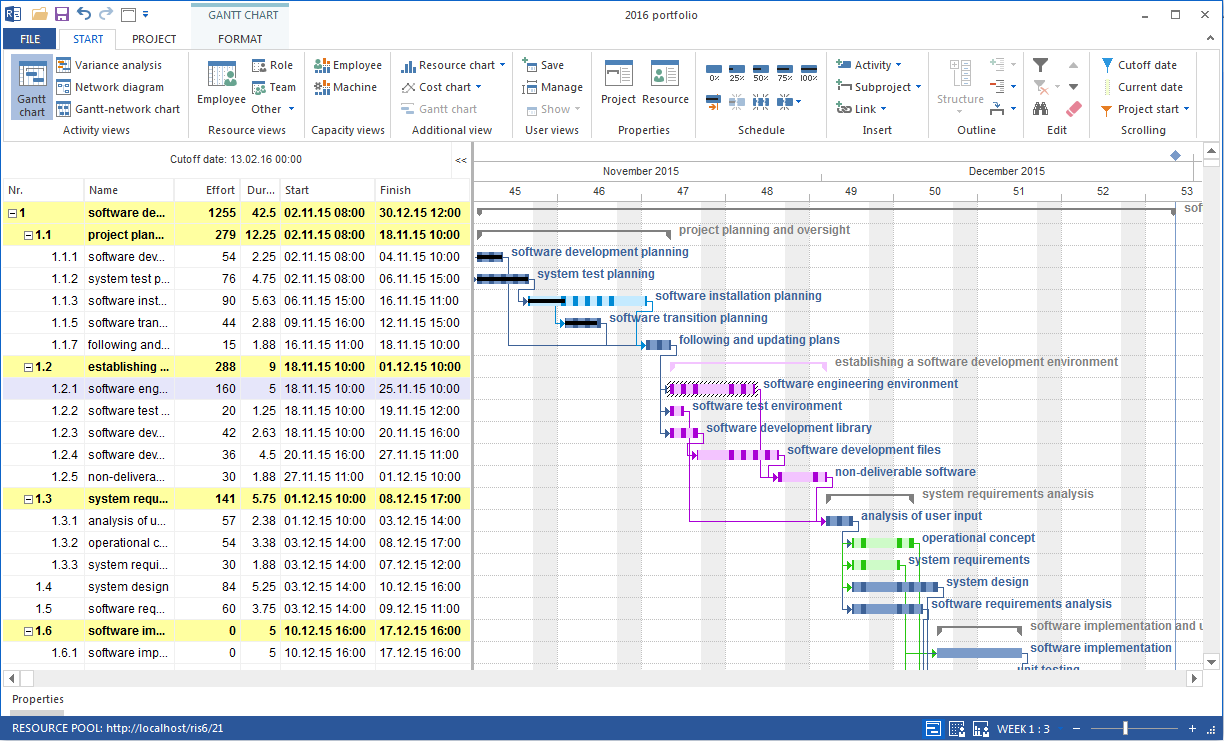
Good review material contains the affected projects, the bottleneck qualification or resource, the timing, the available alternatives, and a recommended decision.
Create the decision basis from Rillsoft Project:
Open the portfolio and sort all projects by priority.
Check project-specific employee capacity balancing: which project uses which qualification most strongly?
Temporarily remove projects from the calculation for simulation and compare the resource situation.
Check dates and overlaps in the portfolio Gantt chart.
Prepare the result as screenshots or Excel output for the review.
Common review mistakes:
The review takes place, but the data in the tool is not current.
Status reports are presented, but no decisions are made.
Resource bottlenecks are named but not connected with priorities.
Simulation scenarios are discussed but not documented.
Save Baselines At The Right Time
The baseline is the reference for variance analysis. The timing of the baseline determines the quality of every later comparison.
- Saved too early
The current plan is compared with an immature planning state. Variances are misleading.
- Saved too late
The reference is missing when changes already happened. A later baseline may reflect the current situation instead of the approved plan.
Save the baseline when:
the schedule has been reviewed and approved
resource demand and capacity balancing are complete
important employee assignments are made
costs, effort, and milestones are binding
the project officially enters execution
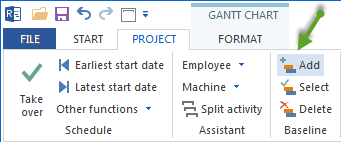
Use multiple baselines deliberately:
Baseline 1: original approved plan.
Baseline 2: revised plan after an approved change.
Baseline 3: plan after scope extension.
Each new baseline should document why it was saved.
What a baseline does not replace:
A baseline does not replace the documentation of plan changes. Record important changes additionally in the project log or status report; the baseline alone does not explain why the plan was changed.